by Ed Fortune
Ivan Van Norman is the co-owner of Hunters Entertainment and Head of Critical Role’s publishing house, Darrington Press. Ivan has been producing TTRPGs for quite a while now; we caught up with him to talk about the narrative duelling card game Till The Last Gasp and also about the future of Darrington Press.
STARBURST: How would you describe Till The Last Gasp to a family member who’s just starting to play board games?
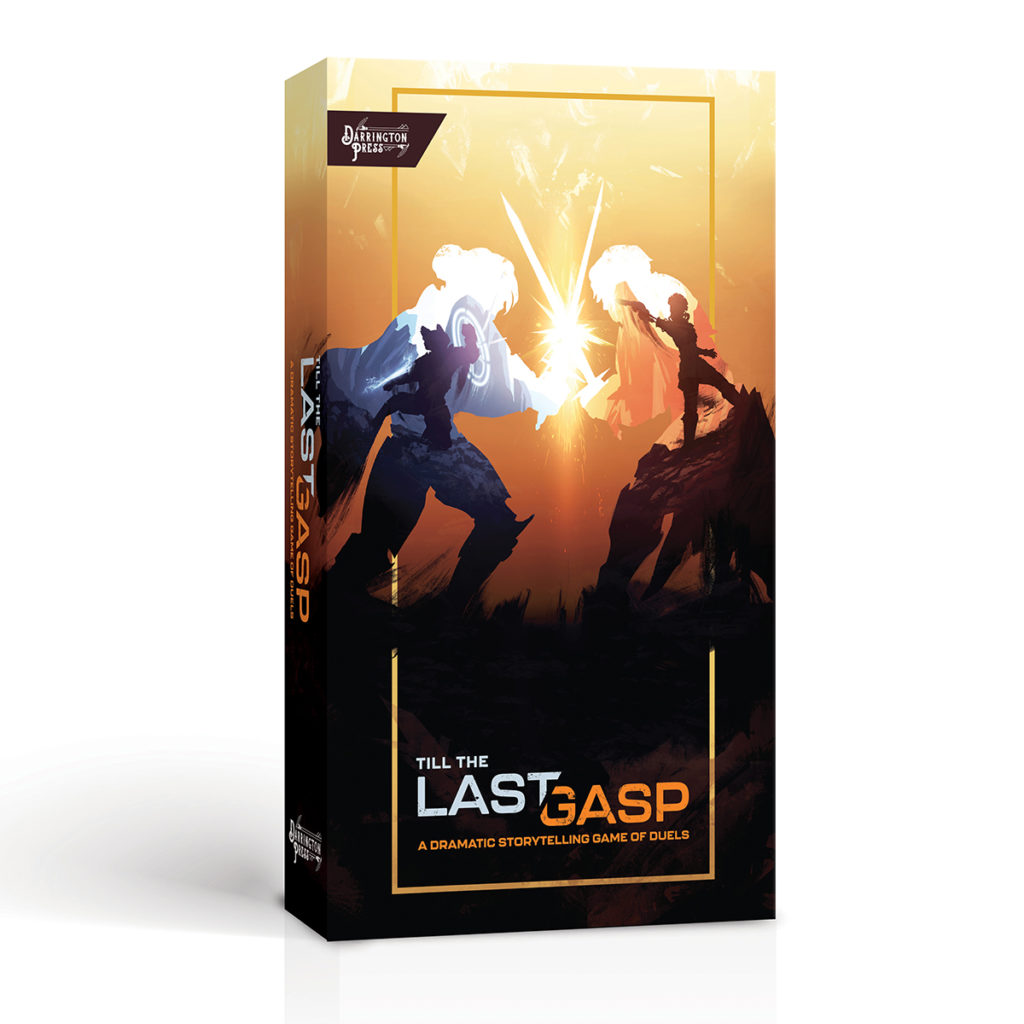
Ivan Van Norman: It’s a storytelling game, which means it’s odd. It’s not a board game. And it’s not an RPG. Although it shares a lot of similar concepts with both, like a lot of shared DNA. The goal is to experience the story. Unlike a role-playing game, but similar to a board game, it’s actually a game you can win. There is a decisive winner to the duel at the end. And that is the process of actually seeing the game versus a role-playing game, which, as people might have heard of with D&D and other kinds of standard RPGs, it’s a game that is ongoing and ongoing and ongoing and requires a Game Master to help facilitate the story and this, you don’t need a Game Master at all. You just play between two people; two people sit and help collaboratively tell the story together. But there’s not that third-like adjudicator that you often see in role-playing games. So it’s a weird hybrid of both. I’m not saying it takes the best of both, and I’m not saying it takes the worst of both, but it is just a beautiful blend between trying to find a through line with the story but also having a decisive outcome at the end of it similar to a board game.
It seems very flexible in terms of story because you’ve got all sorts of different characters, which feel like they could be from anywhere. Is it set in a specific world?
Yeah, so it’s crazy. We call it a sandbox game, right, like it’s a tool chest. It’s like a kitchen sink genre game, right, because it doesn’t have a set world. It is like a tool belt. Till the Last Gasp honestly acts very much like a power tool in your storytelling utility kit. We have a lot of preset maps and genres and things inside of it. But the game is really designed to provide you with a system in which to tell a cool duel between two interested parties. One of the things that made the game so interesting to me is how seamlessly it fits into like a long-term campaign of D&D, Pathfinder, or Starfinder, or just as a standalone. You can play it in 90 minutes with a friend just to kind of hang out and play a cool duel, or it can be this beautiful, intricate sidebar or, you know, an offshoot of a major campaign. So that way, I think it has a crazy amount of utility, but it does not exist in like a preset world, which is what a lot of people are used to when it comes to both Darrington Press and Critical Role. They’re used to seeing Exandria and Exandria stuff and everything being in Matt’s world.
This is an interesting departure for Darrington Press. It feels like it’s a bit of an experiment to see how far you can expand the genre.
Only time will tell. Yeah, yes, no, one of Darrington’s big goals has always been to explore stories and concepts outside of the world of Critical Role. There are a lot of great stories out there to tell. But you know, it doesn’t all have to be exclusively out of the wide-spanning world that is Matt and Exandria that now features other GMs such as Brennan and Aabria.
Till the Last Gasp is designed by Will Hindmarch and Alex Roberts, both of whom have done some very interesting work in the past. Did Darrington Press seek them out, or did they come to you?
Will came to me initially to kind of talk about the game and talk about something he wanted to do. And I have been a big fan of those games in the past, like I played, The Quiet Year, I played. Dialect. I helped help Spencer Stark create Icarus and Alice is Missing when I was with Hunters Entertainment. So I’m used to these non-GM facilitated storytelling games. It wasn’t a new concept for me, but I had never really seen a duelling one like this before. That being said, I’m a huge fan. Will brought it to me initially, but I’m also a huge fan of Alex Roberts’s work, especially For The Queen and a lot of these other storytelling titles as well, too. And I just really felt like it was a perfect pairing. Like, I’m a big fan of, like, when a design comes in, do you want to challenge the design to be better? Always, right? It’s very rare that you get a single designer that just hits it out of the park without ever having another designer come in. It’s because there is so much playtesting, so much iterating, and so much work; it basically isn’t their design anymore. So I’m always a big fan of like setting up designs in order to see how it suffers against other designer concepts, you know, again, long as they aren’t two different design philosophies competing against each other.
Till The Last Gasp does feel like a series of dramatic prompts, almost like tools for your inner actor. Is that the intended ‘style’ of Darrington Press games? Is there an intended style?
Yeah, so that’s an interesting question because it has been coming up a lot of, like, what’s Darington’s voice? And even though the company has been around for a few years already, I would say it’s still finding its voice; it still wants to discover who it is; it’s still very much in that, like, freshman year of college, I’m going to pick a major, but maybe I’ll change it in a year, kind of a vibe. That being said, the through line that we do have that is very clear to us is that we are here to tell stories. Whatever comes out, we want games that help tell stories and are very cinematic in the way they exist in your brain. We don’t just want to create games for people who want to do improv; I think those games are great, and I do enjoy them, but not everyone wants to play an active game, so I’m interested in seeing those games under our umbrella as well.
Darrington Press’ output is very good, but it does take its time to come out. What’s the process? Do you take lots of things and whittle them down until you have the final product, or is one idea that’s constantly being refined? Is it a perfectionist approach?
I think it’s a little bit of columns A, B, and C, right? Like you want to take your time with it, you want to make sure it’s good. We are very grateful to be in a process where we can go into a design and say, “Is it is it what we want it to be?” even after spending some time with it because creatively, stuff evolves and always does. Even during the pandemic, I wanted to try to meet as many designers as possible to talk about their games. And it is usually about finding the right one; one of the things that I’ve enjoyed as a producer over the years is just really identifying passion and opportunity in games. Because even though there’s a great opportunity, if there’s no passion, it will probably not see itself to the finish line. And vice versa, if you have a great game, but you’re not, you know, finding a creator or someone who’s really passionate about their process and their progress, you’re going to just run into issues and in, you know, hurdles and difficulties throughout the entire step that doesn’t make anybody happy. I found a lot of great games. And I found a lot of great designers. Sometimes we make it through to the point where we can work on stuff together. And that’s the stuff I get really excited about. But it takes time to do all of it. Like we, I’m really I’m happy that you’ve identified that we are a quality-over-quantity kind of company because that is definitely the cadence that I want to keep. I would prefer to put out really beautiful games that play well and are replayable and timeless.
You mentioned expansions; when should we be expecting them?
Well, that is, I like to leave that up to the market quite a bit in the fan base. You know, I think I think it’s a little bit of hubris to plan expansions for games that I don’t even know if people like yet. If Till The Last Gasp comes out, and it people are really soaking it up and really enjoying it, and I see a lot of content come out of that game and bringing stuff together, then, you know, hell yeah, we’re going to support that. But right course, we’re going to make sure that people are continuing to be heard if they’re enjoying that game in that process. At the same time, I’m always excited about the next game as well as the next opportunity.
What games are you enjoying?
I played a lot of Gloomhaven, kind of like, three or four years ago; I played it a lot. And we went through the campaign, and we played it over the course of, like, two years like I watched my, my small child, my small baby become a toddler and then become a child through the process of Gloomhaven. So, needless to say, we have Frost Haven in our house now. I’m just a huge fan of a game that is so thoughtful in its process. That is a thoughtful game as far as how they do design and elements in there. But we also are enjoying My Father’s Work. I love that. I got the I got I played a bunch of prototypes, which, you know, I wish I could talk about, but I can’t. I did. We also played a delightful little game called that was called Deadwood 1876. It’s a card game of strategy and perceived luck. It’s from a company called Facade, and I actually never heard of them before. It’s a very wonderful kind of beer and pretzels party game for two to nine players. I was very impressed at how easy it was. It’s a party game without the referee style you get in party games. It’s good to see everyone else is doing it. Clever Girl is another one. It’s a solo game; you can play it by yourself right here. By Wretched and Alone. Basically, you play the human, and you play the Raptor. And you can do cooperative play, or you can play semi-competitive play where you know, you are, you are trying to survive against crushing odds that both the Raptor version and the human edition of the game.
Are we heading back into an era of wild invention when it comes to gaming?
There’s a game for every table, right? And there’s a game for every gamer. Because no matter what you enjoy, whether and this is why it’s like there are these archetypes that people were like people who just will not touch games out there, and you think about like, those kinds of tropes, and I want to challenge those tropes. That’s not a good business model. You don’t just go find that niche market and then try to serve as the niche market. But at the same time, personally, I think it’s very fun to say like, how do I get people who are traditionally not into games and find something that makes them delightful, but not, but not shoved, but like, Hey, this is the game for non-role players, right? I see a lot of those games right now. I see a lot of the people who are trying to make the role-playing game for not role players, and coming out of the gate with that kind of a statement, I think, is the wrong way of going about the game design, instead of just trying to say, hey, you know, I’m going to make it easy, right? Instead, you just need to say, well, what can make it delightful, right? How can I make an experience so pleasant? To enjoy? That kind of level of integration? That I am, that I just, I just, I want to buy it, right? Because that’s what’s more important, are they having so much fun they want to keep playing? Or do you just want to make it so easy that it’s not difficult to play? Right? That’s kind of two different attitudes towards it.
People like having fun, yeah?
I am coming, literally, from a world of seven-plus people all sitting and playing a game filled with joy, right? And an entire brand built around the joy of the game and the joy of the process. Right? And then, you know, people discovering that joy and wanting to buy into it, right? So I don’t think a UI UX experience needs to be any different than then watching people laugh and joke and find camaraderie and be, again, to use the word delightful around each other.
Till The Last Gasp is out now via all good games stores. And check out Darringon Press’s quick start rules for their forthcoming Candela Obscura game here.