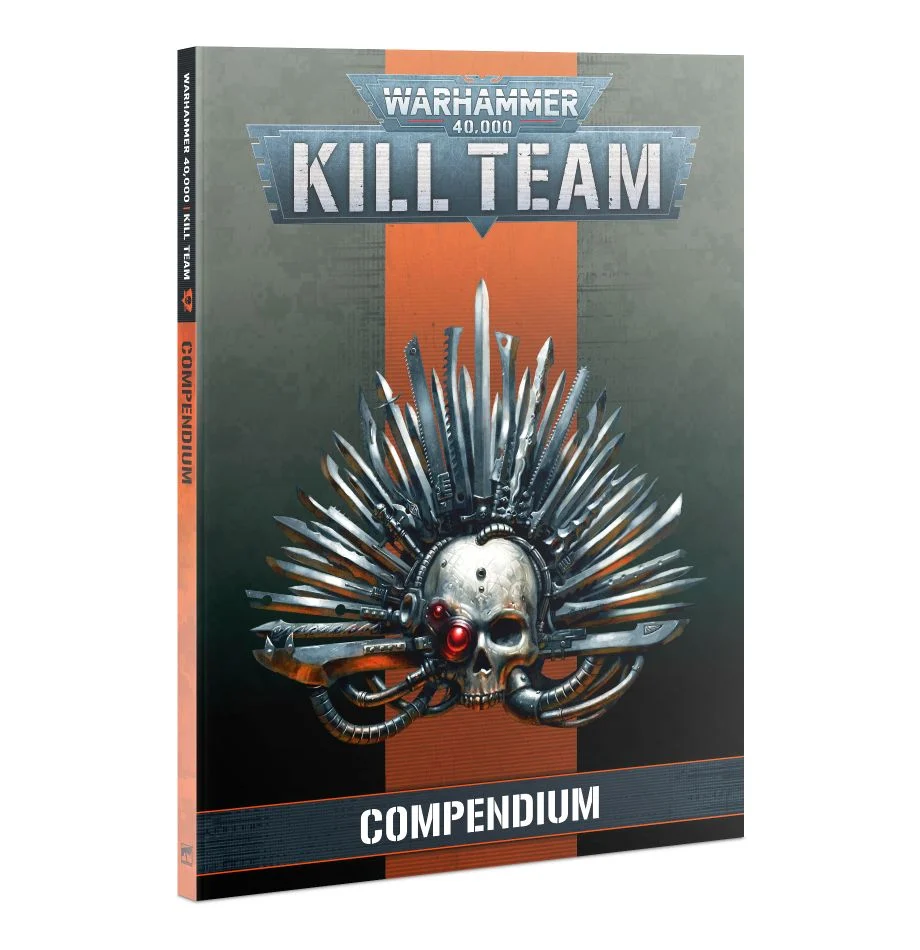
The new edition of Warhammer’s 40,000 sci-fi skirmish game Kill Team, called (appropriately enough) Kill Team Octarius has just launched and it completely overhauls the extremely popular (and quick to play) miniatures wargame. The new box doesn’t contain rules for the models from the older edition (why would it?) so of course, this means that Games Workshop has produced a whole new book. The Kill Team Compendium lets you take your old squads and put them into the new game.
Except that’s only sort of true; the way units are constructed in the new game is quite different and it boils down to more models but less variety, unless you’re playing narrative campaigns. This is clearly to make the game more suitable for competitive and tournament play which this new game does excel at. (Though if you’re not playing the odd narrative game as well, you’re really missing out.)
The book covers pretty much every faction you’ll want to play in Warhammer 40,000. They are some exceptions; Knights don’t appear in Kill Team because they’re office block-sized robots and thus don’t really do stealth. Older teams like the Starstriders or the Gellerpox Infected aren’t covered either and before someone asks (because someone always does), no, Squats aren’t in here either and haven’t been a thing since the early 90s.
We aren’t going to a full blow by blow for each of the nineteen factions presented in this 167-page manual, but we did carefully comb through the rules and were struck at how very balanced this game is. You’d expect a fight between Space Marines (power-armoured super soldiers) and Genestealer Cultists (fanatical human infected with alien DNA) would be a lopsided fight and though that is true, both sides have enough options available to them that the game becomes fun. On the face it we thought factions such as the Custodes or Tyranids would stand out as clearly superior, but we were delighted to discover that a band of Harlequins can still cause either of these factions a huge and lethal headache. It’s a tactical game with a lot of moving parts, but they’ve really done quite well in terms of balance and fun.
The problem is that the options available to each faction that are clearly optimal over others. This means that though they are choices to be made, some of them are simply bad. For example, some of the close combat weapons just have better stats than the others and there’s no downside to taking the better thing. Necrons and Space Marines suffer the most here; the choices are quite limited compared to the other factions. This makes the game a little unfriendly to new players who may miss some of the nuances, but if you’re steam-rolling new gamers with your maxed out units then you probably need to have a word with yourself anyway.
We did find it interesting that the units in Kill Team Octarius are just better in terms of flavour and rules, and we suspect that new Kill Team boxes will be more interesting than the things you can make with the Compendium. The book is a little bland, but it’s essentially a stats manual designed to move your game from one edition to the next, it was never going to be a gripping read. Overall though, it’s a good sign of what’s to come and we have high hopes for the future of Kill Team.