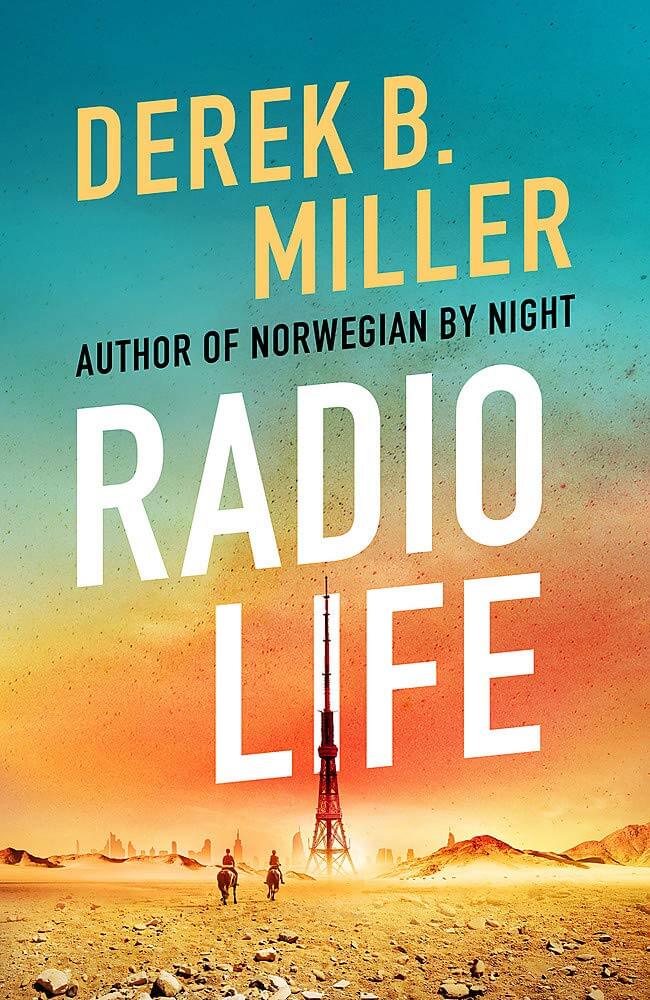
New political thriller Radio Life is from that genre of post-apocalyptic fiction that opens following a time-jump between the calamitous world-changing event and the beginning of the story. Hundreds of years on from the moment in which civilisation, industry, and society were all destroyed, humanity has emerged afresh from the ruins in a new if rudimentary society. With little knowledge of the old world remaining, new tribes have emerged amidst the descendants of the survivors; each asserting their own identity and suspicious of (and sometimes hostile to) their rivals.
At the heart of this new frontier world sits The Commonwealth, a small community that has withdrawn into a defensible citadel and which remains committed to the ideas of progress and enlightenment. Under the direction of archive boss Lilly, Runners are dispatched into the outside world to unearth remnants of ancient knowledge and technology and return them for analysis. When a talented Runner named Elimisha is entombed in a collapsing building she uncovers a connection to something a robotic AI calls ‘the Internet’.
But the opportunity to access unimaginable quantities of information from the past comes at a moment of crisis. Not only is Elimisha trapped, with only a radio to send out messages she has no idea if anyone can hear, but hostile forces are preparing an attack on the Commonwealth’s stadium. The Keepers are fervent believers that any attempt to access the history of the past will result in disaster and the ruination of the world as it is now. The question now is whether Elimisha’s discovery can be returned to Lilly and her team of experts before the Keepers burn the Central Archive to the ground?
The central conflict of Radio Life is not especially ground-breaking. The struggle between those who wish to recover and leverage the expertise of an earlier lost world and those convinced that ‘old knowledge’ will destroy the present is a recurring one across the breadth of disaster fiction.
It’s a theme that, back in the 1970s for example, featured in sci-fi storytelling as diverse as Planet of the Apes, Survivors, and Logan’s Run. The way that the idea is explored here is reasonably engaging, but not in a way that brings innovative new perspectives to this existential dilemma.
Christopher Miller takes time to set in motion the decisive showdown of his novel. That reckoning is prefaced by a couple of hundred pages of world-building, and the gradual revelation of post-disaster history. The book is at its strongest when fleshing out its large ensemble of characters. Miller draws his female protagonists particularly well, populating the different clans with capable and self-possessed women of all generations, backgrounds and temperaments.
But its political assuredness, and its detailed sense of place, end up making Radio Life a measured and thoughtful story of a future dystopia, rather than one infused with any breathless sense of energy and excitement. A book that will leave your mind musing rather than your pulse racing.
Release Date: January 21st.