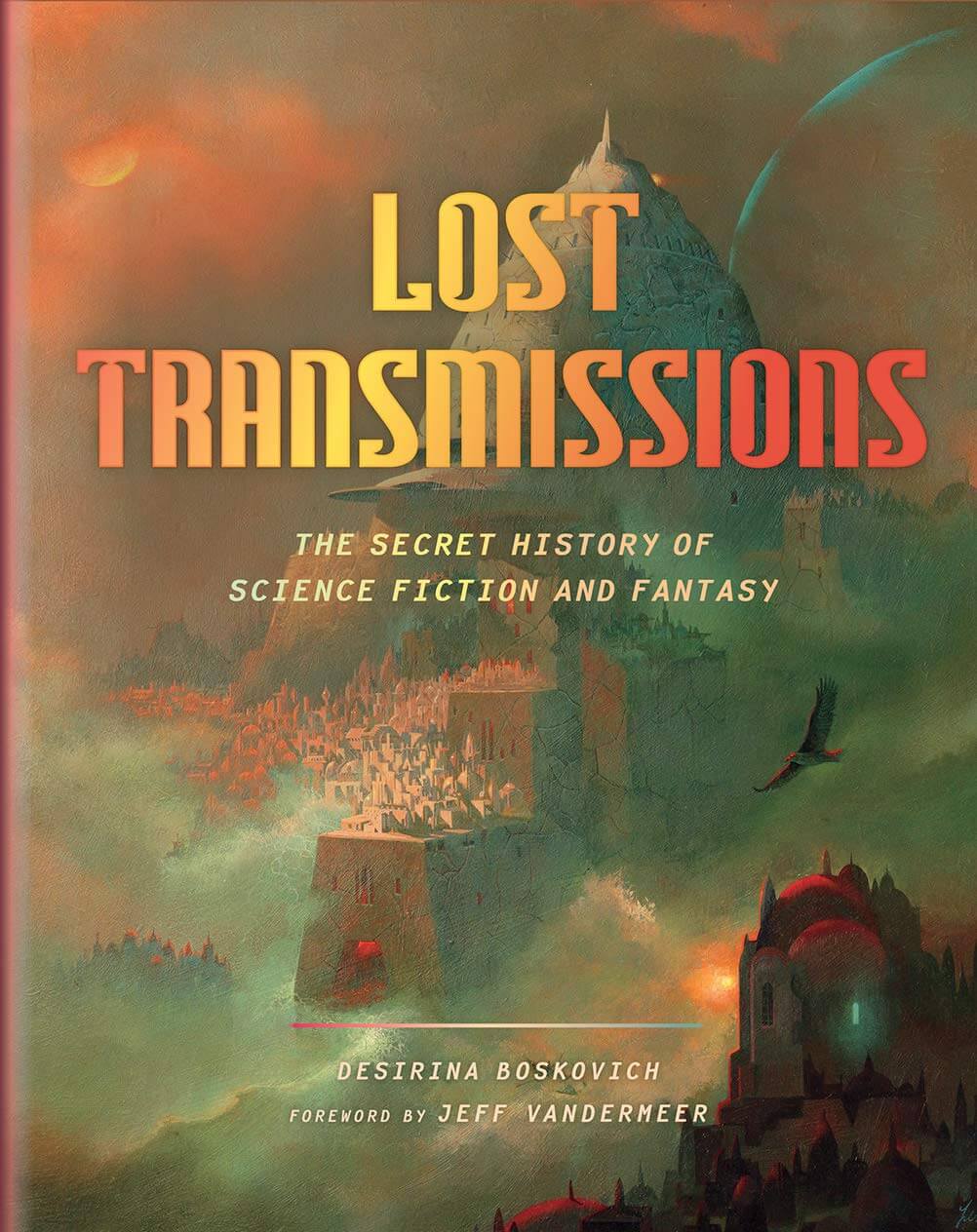
LOST TRANSMISSIONS: THE SECRET HISTORY OF SCIENCE FICTION AND FANTASY / EDITOR: DESIRINA BOSKOVICH / PUBLISHER: ABRAMS IMAGE / RELEASE DATE: SEPTEMBER 10TH
The objective of Lost Transmissions is to tease out and illuminate the corners of science fiction and fantasy that never saw the light of day or has been forgotten and banished to obscurity.
This adds up to a wonderful treasure trove of contributions from science fiction authors who guide us into these alternative dimensions of the imagination. In five sections they look at literature, film and television, architecture, art and design, music, fashion, fandom, and pop culture. That’s a pretty impressive range of topics and the two- to five-page-long essays are very easy to read and are accompanied by vivid colour illustrations and artworks.
The literature section has features on Jules Verne’s worst rejection letter (we’ve all been there!), feminist utopias, a piece on George MacDonald, who is a forgotten father of modern fantasy, the legal consequences of Johannes Kepler’s proto-science fiction manuscript Somnium, and Robert W. Chambers, who is shown to be a lesser-known father of weird fiction.
Besides being forgotten, some works have never seen the light of day because they never got beyond the concept stage or circumstances have banished them to the twilight zone. One good instance is outlined in the chapter ‘Harlan Ellison’s Legendary Lost Anthology.’ His Dangerous Visions, a collection of new wave writings, set the benchmark for SF writing and five years later in 1972 he produced a follow-up anthology. All was going smoothly until Harlan announced his intention to produce The Last Dangerous Visions, which would be an anthology to end all anthologies. The project escalated from being a selection of 68 stories to more than 100 by 1976. He kept collecting stories and promising publication dates, but the project haunted and bugged him until his death in 2008. As a consequence of this literary black hole the best work of some of the era’s best writers was never published.
Another example of someone being overwhelmed by the size and scope of their vision and ambitions is good old Philip K. Dick, who was zapped by a ray of light in 1974. This filled him with so much raw unfiltered knowledge that he spent the rest of his life writing what he called the Exegesis that ran to 8,000 pages long. They became the basis for his VALIS trilogy but stand out as being a record of a restless mind trying to deal with the slipper concept of the interface between reality and the human mind.
A beautiful coffee table book that stretches the imagination to infinity and beyond.