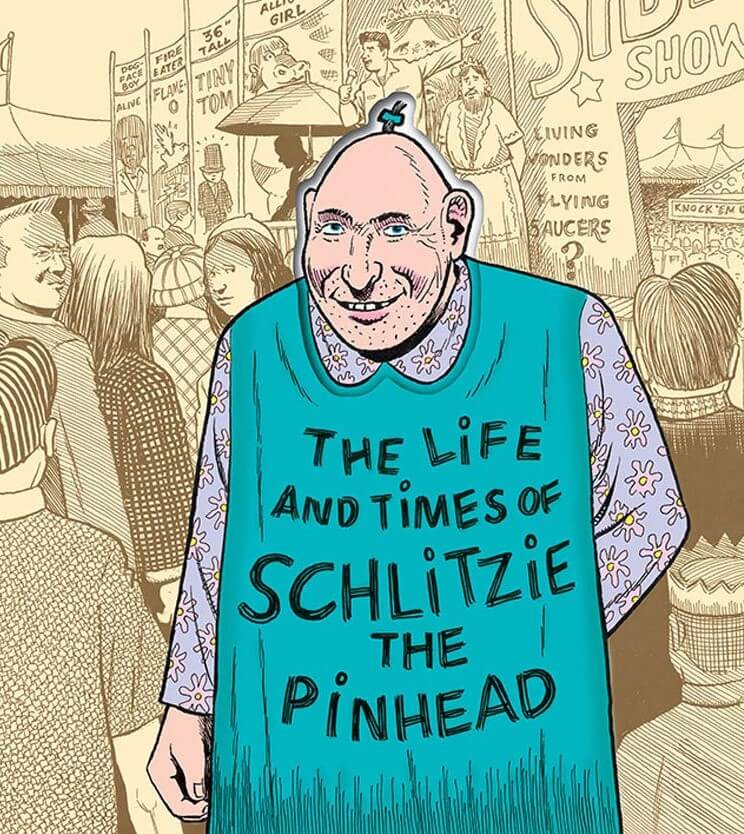
ARTIST: BILL GRIFFITH | AUTHOR: BILL GRIFFITH | PUBLISHER: ABRAMS COMICARTS | FORMAT: HARDCOVER | RELEASE DATE: OUT NOW
Anyone who’s an aficionado of Hollywood’s early horror films will be more than familiar with Tod Browning’s notorious 1932 film Freaks. Vilified on its initial release Freaks was banned in several states, and in the UK for over thirty years. The film’s notoriety transformed it from a piece of mere celluloid into a tantalising forbidden fruit. Cartoonist Bill Griffith was one such person who became mesmerised by Freaks, in particular, the Pinhead character, after catching a revival showing. Seven years later Griffith created Zippy the Pinhead, a wildly successful syndicated newspaper cartoon strip inspired by the circus performer Schlitzie, seen in Browning’s movie. But just who was this mysterious person?
Written and illustrated by Bill Griffith, Nobody’s Fool: The Life and Times of Schlitzie the Pinhead is an affectionate tribute and biography that charts the extraordinary life of this enigmatic performer. Griffith states in his introduction that much of Schlitzie’s early life is unclear, but he has done a remarkable job of extrapolating what information he could find to reasonably assume that Schlitzie was born with microcephalus in turn of the century New York, christened Simon Metz, before being sold to a circus when still a child and cared for by the other performers.
Schlitzie’s entertainment career is more factually accurate as Griffith’s interviewed several people who worked at the circuses and carnivals with him. What is clear is just how loved he was and how much he enjoyed being with his circus family. He was always billed as a woman under a myriad of pseudonyms; examples being Tik-Tak the Aztec Girl and The Missing Link. Naturally, the focus is heavy on Schlitzie’s performance in Freaks, but it also reveals Tod Browning’s own background in circus sideshows. And that’s partly what makes this graphic novel so great, the insight into the life of a sideshow freak and just how popular these exhibits were. Griffith also addresses the moral issue, as many considered freak shows to be exploitative and degrading, but for the performers, it was liberating and a way to make a living, a living that would otherwise be denied them.
Griffith’s black and white art suits the project perfectly. It’s highly detailed while demonstrating his cartooning background, but coupled with his writing it is a work of bitter-sweet pathos. Because of his microcephaly, Schlitzie’s intelligence didn’t develop much beyond a young child’s yet he found joy in the simplest of things, particularly music. He loved unconditionally all those that showed him compassion and for those that cared for him. Nobody’s Fool is, in turns, funny, heartbreaking, but ultimately triumphant. This book should be on the education curriculum as a template of how to be a decent human being. We’re sure Schlitzie would think that was ‘Boffo!’