AUTHOR: BRIAN WOOD | ARTIST: ROBERT CAREY | PUBLISHER: DARK HORSE COMICS | FORMAT: SINGLE ISSUE | RELEASE DATE: OUT NOW
There are still no Aliens in this Aliens book, but plenty of Resistance from Amanda Ripley and Zula Hendricks, who continue on their perilous mission to find out and put a stop to whatever it is Weyland-Yutani are up to. The mystery deepens as the pair investigate a hijacked colony ship, which shows signs of xenomorph damage and whose passengers have been abducted by the corporation.
No Aliens, but those pesky androids are playing up again, and our intrepid heroes are attacked while attempting to find their way onto the ship. Said androids were as prolific a threat in Alien: Isolation as the actual Alien, so it’s good to see that they’ve made their way, in some manner, to the pages of Resistance. When or where exactly the all-drooling, all-dismembering Alien itself will show up is another matter, and Issue #2 is another xenomorph-lite episode of the story, which may frustrate some.
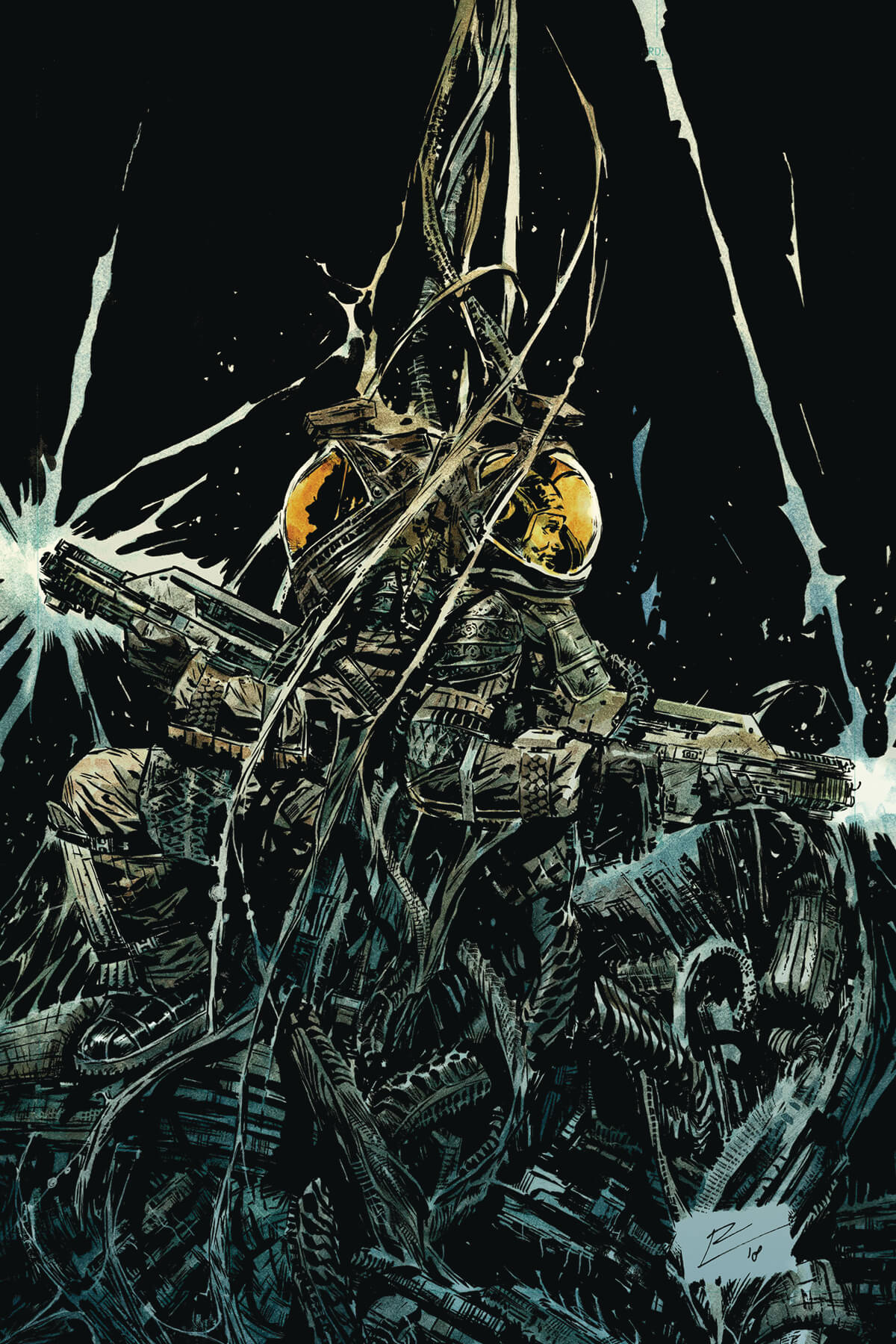
Robert Carey and colourist Dan Jackson keep the atmosphere oppressive and moody, even in the absence of any tangible threat. Both the interior and exterior shots of the Gaspar are well-done, at once intricate and minimalist. Their depths of outer space are cold and twinkly at the same time, and the action clean and easy to follow. However, in the absence of any real scares or action, this minimalist style does begin to grate a little, and Resistance #2 can feel Spartan and hard to engage with at times.
This holds true of the writing from Brian Wood too, whose characterization of both Ripley and Hendricks doesn’t give the reader much to work with, beyond the vaguest sense of one being spunky and the other being, uh, a Ripley. Which isn’t to say that there’s not room for growth, but without its central threat, one would like the book to give us more than it currently is in terms of character and plot.
Still, its central mystery remains engaging; particularly in the chapter opening, which gives readers a much-needed glimpse into the machinations of Weyland-Yutani’s current scheme. Both the art and story are as strong here as they were during the first issue, and it feels a little harsh to rail against that which made #1 such a compelling opening chapter. Nevertheless, such minimalism and slow eking out of plot points does tend to lend itself to impatience on the reader’s part, no matter how beautiful Resistance’s deep space isolation tends to look.