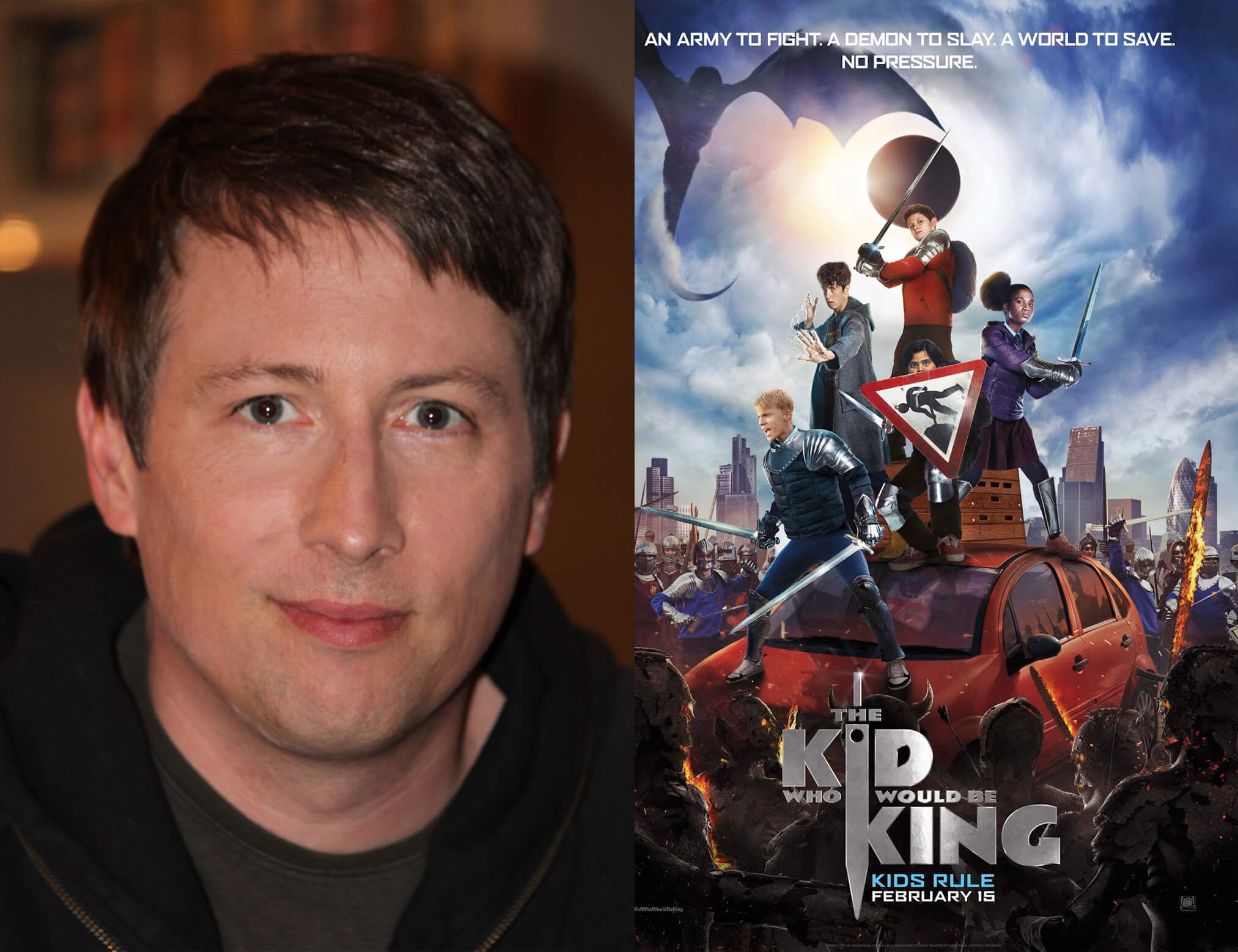
It’s been the better part of a decade since writer/director Joe Cornish gifted us with his brilliant Brit sci-fi film Attack the Block. Eight years later and he has finally returned to the director chair with an equally excellent, family/ fantasy adventure. The Kid Who Would Be King tells the story of a boy called Alex (Louis Ashbourne Serkis) who discovers the mythical sword in the stone sticking out a slab in a London building site. The discovery triggers a series of events which sets Alex off a quest to save the world and learn the truth about his heritage in the process.
STARBURST recently met with Cornish to talk about his latest project and what he has been up to over the past eight years. We also discussed the films he nearly made, what it was like to have creative control on a big budget studio feature, his time co-writing Ant-Man and Tintin, and how The Kid Who Would Be King was part inspired by RoboCop.
STARBURST: You first came up with the idea for The Kid Who Would Be King when you were a kid yourself. How did you find developing it as an adult?
Joe Cornish: Obviously quite a lot of time has passed since I was twelve or thirteen! Back then, I had the idea for the set-up and that Merlin would be young and back in school. I also had the idea for the climax: this big battle where the kids defend the school like a medieval castle. It was the middle that I had to work on as a grown up, but I didn’t come back to it until about 2012.
It sometimes felt like a film from the ‘70s and ‘80s, the era when it was first conceived and partly recalled British kid’s TV films from that time like The Boy from Space and The Spaceman and King Arthur. Were you inspired by other films from that era while writing it back then and years later when developing it?
The thing that’s unusual about it is that it’s a live-action film for kids and starring kids. That kind of film doesn’t really get made anymore. Children have superhero movies which are full of adults playing dress-up. They have animated movies that are usually also about superheroes or based on famous toy-lines, but the era of making films for kids, starring kids, is something the industry has forgotten. I found it very exciting as a kid to go to the cinema and see myself on the big screen. So for people of my age, it evokes an era where you saw kids in live action adventure films.
As well as the King Arthur legend, mythologies and action, at its core was also a lot of deep, family drama and interesting characters which embellished it with so much heart. Did you draw from any personal experiences while writing that part of it?
It’s a thematic thing really. I noticed that in classic British family films and stories like Star Wars, Harry Potter, Oliver Twist, King Arthur and a lot of famous British stories… well, Star Wars isn’t British. Anyway, in a lot of famous myths, there’s this notion of an orphan who finds out they were abandoned by some magical or powerful relative then reclaims that inheritance. I saw that in lots of big children’s myths and thought it was a strange message to be putting across: the notion of being an individual with a hereditary specialness.
I wanted to write a story that countered that narrative and that’s really why Alex’s circumstances in the film are what they are. Why he wants to go on this journey and why his expectations are subverted. So that’s where that came from, and it also happened to tie into a common element in in ‘80s kid’s movies: divorce. Divorce was a new thing in the ‘70s and ‘80s; something that specific generation and society was adapting to and experiencing for the first time, so it got sewn into the fabric of a lot of ‘80s films. It’s the combination of that thematic story that I wanted to tell and trying to evoke the spirit of the movies from that era that I used to love.
Was it relatively easy to get green-lit considering it’s not based on a franchise and did the script go through any further changes following that?
There were quite a few re-writes but we did it quite quickly. I wrote it in 2015 and we were greenlit the next year then pre-production started in 2017. But because it’s an idea I’ve had from an early age, I have always been collecting bits and bobs and building it up in my brain. I also researched which was a very important stage, then went out into the world and found things. I went to Tintagel then to Bodmin Moor, visited all of the locations and took photos.
You had those gorgeous moors and countryside, but you also captured a side of London not typically seen in blockbuster fantasy films. There are hardly any red buses, phone boxes or famous landmarks getting destroyed, just chicken shops, road signs, building sites and backstreets. Were you trying to steer away from the identifiable sights to help it connect to an international audience?
We wanted Alex to be the most ordinary boy in the country, living in a very ordinary environment, so we didn’t put him in central London. It’s not like Attack the Block where we were using the architecture and socio-economic space as part of the story. He is supposed to be a suburban, pretty nothing kid, who feels like he doesn’t have any agency or influence in the world. The important thing in the film is the countryside: Bodmin Moor, Stonehenge, and Tintagel, the standing stones and the ruined castles. We wanted to tie the fantasy elements to reality to show that there is all this history, mythology and fantasy all around us; magic that we can’t see because of all the chicken shops and car parks. And that we live in a reality where you can scratch the surface of a car park in Leicester and find Richard the Third beneath it.
Both of your films as director are sci-fi/fantasy films about a group of kids. Are there other genres, styles of filmmaking you would like to explore?
It is interesting that they are both kids’ adventure films, but Attack the Block is definitely for an older audience. It’s got swearing and drugs and throats being ripped out whereas The Kid Who Would Be King is very much a family film. I don’t know why the both ended up being about gangs of kids with weapons setting out to save the day. I did try and do something different. A bunch of stuff I got attached to as a director fell through, like Snow Crash for Paramount, based on Neil Stephenson’s novel, and Section 6, which was the origin story of MI6. Both of those were very different, but this was the one that ended up getting financed. Maybe it’s because they saw something similar and made connections, I don’t know. I do have lots of other genres and ideas in mind though, including a fun idea for a horror that I really want to do.
Do you think you would feel more comfortable working on smaller scale projects, outside of the studio system?
Attack the Block was Studio Canal, which was more indie, but The Kid Who Would Be King is a big studio film with Twentieth Century Fox, yet they felt no different at all. Only this was just on a much larger scale with bigger sets and a longer shoot. All film-making always feels like there is never enough time or money, so it’s always a race against the clock and then there’s the pressure of resources. But it feels very similar. I think maybe because this is not a brand or franchise, I didn’t have that corporate, marketing presence breathing down my neck, worrying that I’ll mess up their toys. That probably took the pressure off. Not to say I wouldn’t want to do one of those films one day if I could find the right project and someone would trust me with it. Attack the Block and this are very much authored and my own thing, which is a great privilege and feels very good. We came up against it a bit on Ant-Man, which Edgar Wright decided to step out of because we didn’t have that creative freedom, but Tintin was very collaborative. I was one of quite a few writers on that.
Even though it’s set in the present day there is something about The Kid Who Would Be King that seems disconnected from our time. There were few references to modern technology, the Internet and social media, which was refreshing and made it feel more timeless. Did you consciously try and keep tech/net references out?
Well there were a few. The kids use their phones to organise the big battle at the end and there’s a little bit of texting at the beginning, but I don’t find people looking at phones very interesting. We wanted to combine the notion of a great quest or something out of The Lord of the Rings or a medieval fantasy with modern kids and ask; can they walk more than half a mile without complaining. Can they survive without the signals on their phones? How would they get on without the trappings of the modern world? There are some very good horror movies that use technology or are shot through phone/web cams. I still think there is a very clever, brilliant film to be made utilising modern phone tech, but for me and adventure films based in the world, staring at phones just isn’t very cinematic.
Thankfully this was. It was also so fast paced and entertaining. I looked at my watch at one point because I thought it was going to end and then was delighted to see there was still half an hour left.
Yes, it does have a bit of a double ending. I became fixated with that. Weirdly, when I wrote it, I had RoboCop in mind: how it came back to the prime directives during the finale. I liked how the chivalric code in The Kid Who Would Be King was a bit like the prime directives, which were set it up in the audiences mind at the beginning of RoboCop. Then at the end there’s that brilliant twist where he fires him and the directives return to the forefront of your brain after seventy minutes of screen time that have passed since you were first told about them. That really propels you back into the finale.
On a final note, many of us grew up watching you on the Adam and Joe show. Did you imagine back then while you were filming puppets and sketches in that bedroom, that you would one day be making a big budget blockbuster for Fox?
I imagined it quite a lot, but never thought it would happen. I always thought it was a crazy fantasy. But I did go to film school and trained as a director. Even before that, when me and Adam were at school, we made loads of Super 8 films at school when we were about fifteen or sixteen. We made a film called Twitch of the Death Nerve. Yes, we stole the title from Mario Bava. That was a modern re-telling of the Sweeney Todd legend. Louis Theroux was in it as the sidekick to Adam’s detective. We made a short film called A Few Friends for Dinner that starred Adam in drag. So my movie ambitions go way back. I feel very lucky somehow to have managed to wriggle my way into actually doing it.
The Kid Who Would Be King is released in UK cinemas on February 15th.