Ursula Le Guin, who passed away in January at the age of 88, was one of the finest authors of speculative fiction of her generation and, as many of her contemporaries would agree, of any other. In her writings Le Guin created worlds of extraordinary vividness, clarity and, however far her imagination took her, of complete believability. No matter how ‘alien’ the setting, Le Guin’s storytelling skills showed just how well she understood the intricacies of the human condition.
As well as being a brilliant novelist and short story writer, she was also a singularly accomplished essayist, speaker and social commentator. Le Guin viewed the world from the perspective of a convinced left libertarian. She was sometimes reticent about being identified as an anarchist and was never completely comfortable with having any label assigned to her. But she was a passionate feminist and anti-militarist, a convinced egalitarian and an insistent advocate for civil liberties and personal freedom. She was deeply suspicious of anyone (politician, populist demagogue or religious zealot) or of any ideology which sought to control the lives of others through the exercise of unaccountable power.
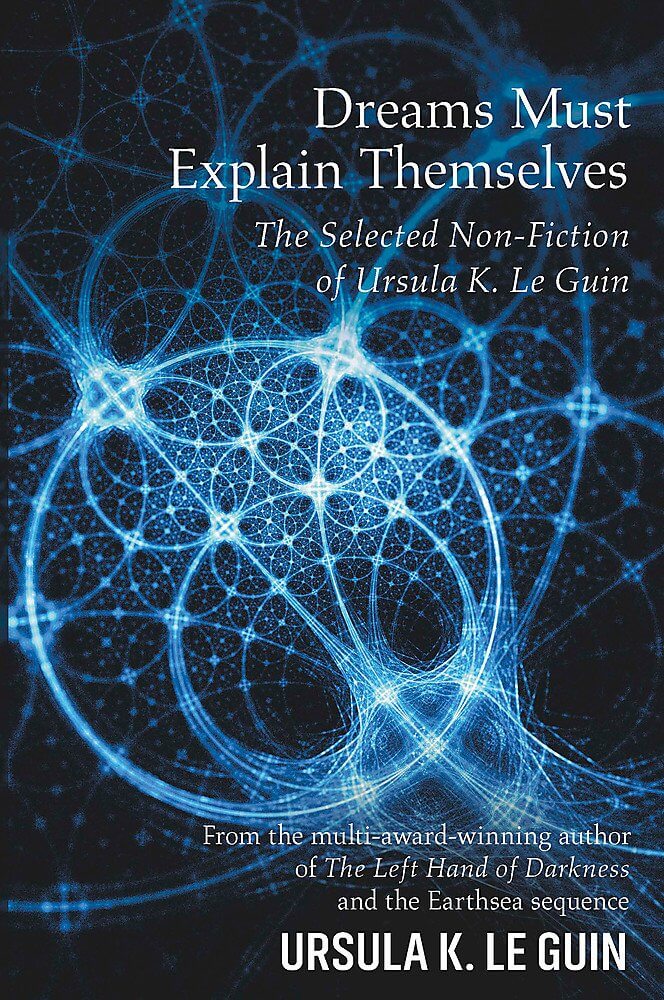
This new collection of her non-fiction brings together pieces which demonstrate not just the persuasive power of her writing, but the breath of social themes and literary questions on which she could bring her impressive intellect to bear. Dreams Must Explain Themselves is the distillation of four previous collections, with highlights selected by Le Guin and her UK publisher, covering the period 1972 to 2004.
In her brief Preface, written just twelve months before her death, Le Guin suggests that her early non-fiction writings reflect the fierce battles for social justice and literary recognition which raged in the seventies and after; while the later pieces adopt a more meditative tone, as progress was secured and inroads achieved (not least, the grudging acceptance in the publishing industry of the power and relevance of science fiction authored by women). After 2004, she laments, the tide again turned in favour of power and privilege, and in response, she had to return to a more assertive, combative style of expression: something a further collection focusing on those later years of her work would attest.
As a political analyst, Le Guin was always self-effacing and remained generous in spirit when others offered their own interpretations of the real-world commentary weaved into her works of fiction. Ever self-deprecating, she describes this collection as “a carrier bag full of ideas and responses, thoughts and rethinkings,” when in reality it’s far more powerful and illuminating than that; a sourcebook of eclectic but interconnected discussions on the liberatory potential of literature and art by an extremely accomplished practitioner of the craft.
This is as far from being a throwaway pulp paperback as it’s possible to get in the fantasy and sci-fi genres. Lit up throughout by vibrant and vital prose, it’s a cumulative tour de force that deserves, and rewards, careful study.
To say that Le Guin “leaves behind an impressive body of science fiction literature” fails to do justice to her extraordinary achievements over many decades as a highly-regarded author. But to fully appreciate the brilliance of her canon of work means paying equal attention to her talents as a perceptive social commentator and political observer, with a catalogue of committed non-fiction to her credit. It’s a reputation that the publication of this welcome collection should do much to confirm.
DREAMS MUST EXPLAIN THEMSELVES: THE SELECTED NON-FICTION OF URSULA K LE GUIN / AUTHOR: URSULA K LE GUIN / PUBLISHER: GOLLANCZ / RELEASE DATE: OUT NOW