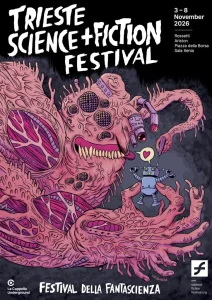

Trieste Science+Fiction Festival, Italy’s leading event dedicated to fantastic cinema, is preparing for its 26th edition, taking place from November 3rd to 8th, and has announced the first films in its programme.
The festival brings the finest international fantastic cinema to the big screen, exploring the many facets of contemporary science fiction: future worlds where nature has vanished, epidemics capable of transforming human beings, liminal spaces from which escape seems impossible, people with extraordinary powers forced to live on the margins of society, and terrifying animal invasions.The five films announced blend science fiction, horror, and thriller elements, and are created by established filmmakers and emerging voices in genre cinema.
“Once again, Trieste Science+Fiction Festival turns to the genre we love and its extraordinary creators to tell the story of, and interpret, the times we live in,”said Artistic Director Alan Jones.“Through the cosmic perspective of science fiction, the titles we are announcing today reflect the social changes we are experiencing and the anxieties that accompany them. In an increasingly unstable world, we look towards the epic, the celestial and primordial forces. From robotic animals and out-of-control viruses to extreme alienation, the relentless pursuit of truth and a fight for survival against an unknown threat, our passionate and loyal audience will find what they are looking for: emotion, adventure, thrills and, above all, new ways of understanding the world around us.”
This year, the Asteroide Award Jury will be chaired by acclaimed director Paolo Strippoli, whose film L’estranea was recently selected as Italy’s submission for the 2027 Academy Awards. The Asteroide Award is the international prize presented each year at Trieste Science+Fiction Festival to the best film by an emerging director in the science fiction, horror, and fantasy genres. Joining Strippoli on the international jury are writer and director Emma Braslavsky, and Morten Haagensen, Artistic Director of the Ramaskrik Film Festival. The Méliès d’argent Award Jury, for a competition organised in collaboration with the Méliès International Festivals Federation (MIFF) and reserved for European-produced feature-length fantastic films, will consist of journalist Valentina Ariete, David Cox, Editorial Director of the British channel Film4, and Martin Unsworth, Editorial Director of STARBURST Magazine and film critic. Finally, the Stars War Critics’ Award for Best First Feature will be decided by Marco Lovisato, Beatrice Pagan, and Simone Soranna.
On the big screen at Trieste Science+Fiction 2026:

OPENING FILM – THE SQUIRREL Markus Lehmusruusu (Finland, 2026)
Markus Lehmusruusu’s The Squirrel will open the 26th edition of Trieste Science+Fiction Festival, where it will have its Italian premiere in competition. This dystopian comedy with ecological and surreal undertones is set in a future where nature and animals have disappeared, replaced by synthetic creatures. Pasi, a solitary designer of artificial animals, finds his life suddenly turned upside down when something that should no longer exist appears in his apartment: a real squirrel. Determined to protect it, he finds himself challenging the rules of a society that has sacrificed the natural world in the name of safety and comfort.
Screened at Fantastic Fest 2026, Lehmusruusu’s second feature film has also been selected as Finland’s official entry for the Academy Award for Best International Feature Film. An ironic and melancholic science-fiction fable reflecting on the increasingly fragile relationship between humanity, technology, and nature, it turns the appearance of a small wild animal into an act of rebellion against a wholly artificial world.

COLONY Yeon Sang-ho (South Korea, 2026)
From South Korea comes Colony, the adrenaline-fuelled new film from Yeon Sang-ho, the director who redefined the contemporary zombie movie with the international cult hit Train to Busan. Screened in the Midnight Screenings section at the 2026 Cannes Film Festival and distributed in Italy by Plaion, the film sees the filmmaker return to outbreak horror, combining action, science fiction, and body horror.
During a biotechnology conference, Professor Se-jeong witnesses the sudden spread of a virus capable of mutating at an astonishing rate. When the authorities seal off the entire building, a group of survivors becomes trapped inside as the infected continue to transform into something increasingly unpredictable and deadly.
Having attracted more than 5.8 million cinemagoers in South Korea, Colony confirms Yeon Sang-ho as one of the leading contemporary masters of Asian fantastic cinema, once again examining human behaviour when social order collapses and survival becomes the only rule.

EXIT 8 Genki Kawamura (Japan, 2025)
A seemingly endless subway corridor, a single possible way out and one fundamental rule: do not overlook any anomalies. Genki Kawamura’s Exit 8 comes to Trieste: an unsettling psychological thriller with a liminal atmosphere, adapted from the independent video game of the same name that became an international phenomenon. Distributed in Italy by Adler Entertainment, the film will be screened at the festival as part of IVIPRO 2026, the event dedicated to video games as a means of telling the stories of places and their cultural heritage.
At the centre of the story is a man trapped in an anonymous underground corridor, searching for Exit 8. To reach it, he must decipher his surroundings, turning back whenever he spots an anomaly and moving forward only when everything appears normal. A single mistake, however, will send him back to the beginning, transforming an ordinary, familiar space into an increasingly claustrophobic and disturbing loop.
Screened in the Midnight Screenings section at the 2025 Cannes Film Festival, Exit 8 transforms the video game’s simple, obsessive logic into a cinematic experience reminiscent of the Backrooms aesthetic, playing on repetition and paranoia. The film stars Kazunari Ninomiya, who previously appeared in Clint Eastwood’s Letters from Iwo Jima. Adler Entertainment will release it in Italian cinemas.

FREAKS II by Zach Lipovsky and Adam B. Stein (Canada, 2026)
A highly anticipated return to Trieste: Zach Lipovsky and Adam B. Stein bring the world of Freaks back to the big screen with the Italian premiere of Freaks II, the sequel to the film that won both the Asteroide Award and the Wonderland Rai4 Award at Trieste Science+Fiction Festival in 2018.
Several years after the events of the first film, Mary and her daughter Chloe are living on the run, concealing their identities and powers while being hunted by the Abnormal Defense Force, a paramilitary unit tasked with eliminating people like them. Mary no longer wants to hide or flee: driven by revenge, she is determined to find the agent responsible for the death of her first daughter.
A violent, visionary science-fiction anti-superhero movie that expands the world of the first film, Freaks II marks Lipovsky and Stein’s return to independent filmmaking following the international success of Final Destination: Bloodlines, which the duo directed in 2025.

CRAWLERS by Ángel Gómez Hernández (USA, 2026)
An invasion of deadly venomous spiders turns an apartment building into an inescapable trap in Crawlers, a horror thriller directed by Ángel Gómez Hernández and starring Matilda Lutz, who previously appeared in Coralie Fargeat’s cult film Revenge and will attend Trieste Science+Fiction Festival.
When a devastating infestation forces the police to quarantine an entire residential complex, building manager Serena and its residents find themselves trapped as the spiders continue to multiply at an alarming rate. Knowing every corner of the building, Serena may be the only person capable of leading the others to safety, but to do so she must confront her deepest fear.
Distributed in Italy by Minerva, the film is a potent blend of survival horror, creature feature and claustrophobic tension, transforming domestic spaces into one enormous hunting ground.
Trieste Science+Fiction Festival will also celebrate the centenary of Roger Corman’s birth, honouring one of the most prolific and influential figures in film history with a major tribute spanning his work as a director, producer and exceptional talent scout.
The tribute takes on particular significance in Trieste, a city that has been connected to Corman’s cinematic history for more than sixty years. His relationship with the event dates back to its very beginnings: in 1963, during the first edition of the historic International Science Fiction Film Festival, whose legacy Trieste Science+Fiction Festival carries on today, Corman’s X: The Man with the X-Ray Eyes won the festival’s top award. It was the beginning of an enduring relationship, with Corman returning to Trieste several times as a festival guest and now stands among the great international figures who have shaped its history.
One hundred years after his birth, Trieste Science+Fiction Festival retraces Roger Corman’s extraordinary cinematic journey through six films, selected to showcase the many facets of a filmmaker who moved with remarkable freedom between science fiction, horror, Gothic cinema, and counterculture, often turning the constraints of filmmaking into an inexhaustible laboratory for invention.
Not only a cult director and tireless producer, Corman was also one of the most important talent scouts in Hollywood history: over the course of his exceptionally long career, he gave some of the first major opportunities to a generation of filmmakers who would go on to change American cinema forever. It is precisely around these multiple identities – Corman the producer and discoverer of talent on the one hand, and Corman the director on the other – that the Festival’s tribute takes shape.
The first part of the retrospective will begin before the festival officially opens, with three screenings at Cinema Ariston in Trieste devoted to Corman’s remarkable ability to identify and launch new talent. Three films and three future masters of world cinema who, at the beginning of their respective careers, found in Corman’s productions a space in which to experiment, learn their craft and develop their own cinematic language.
The programme begins Friday, October 9th at 10:30 pm with Martin Scorsese’s Boxcar Bertha, continues Friday, October 16th at 10:30 pm with Joe Dante’s Piranha, and concludes Friday, October 30th at 10:30 pm with Francis Ford Coppola’s Dementia 13. These three films highlight one of the most remarkable aspects of Corman’s legacy: his ability to turn independent productions, limited budgets and tight schedules into a genuine filmmaking training ground, giving young filmmakers both creative freedom and concrete opportunities that would ultimately enable them to leave an indelible mark on the history of cinema.
The celebration will then move into full swing from November 3rd to 8th during the 26th edition of Trieste Science+Fiction Festival, once again bringing the very best of international fantastic cinema to Trieste, with premieres, talks, and special guests. The second part of the tribute will be devoted entirely to Corman the director and his vast filmography, which spans different genres, eras, and cinematic worlds, from science fiction to horror, from Gothic cinema to satire. From this remarkable body of work, the Festival has selected three films, each representing a different facet of his filmmaking.

Representing the most celebrated and widely recognised side of his work will be The Masque of the Red Death, one of the high points of Corman’s Gothic cinema and one of the defining films in his acclaimed cycle inspired by the works of Edgar Allan Poe. Alongside one of his best-loved classics, the Festival will rediscover two particularly significant films from his engagement with science fiction: Gas-s-s-s, an expression of the irreverent, countercultural spirit that runs through a crucial part of his work, and Frankenstein Unbound, which marked Corman’s return to directing after a long hiatus and offered his own distinctive science fiction reinterpretation of the Frankenstein myth. Together, these three films capture the remarkable freedom of a filmmaker capable of constantly reinventing himself without ever losing his taste for experimentation, independence and provocation.
Making the tribute even more special will be the presence of Julie Corman, producer and widow of Roger Corman, who will be a guest at Trieste Science+Fiction Festival and will introduce the screenings dedicated to the director, guiding audiences on a journey through his work and extraordinary cinematic legacy.
The centenary tribute thus also becomes an opportunity to celebrate one of the figures who best embodies the very spirit of Trieste Science+Fiction Festival: a cinema that is free, curious, popular, and visionary, capable of exploring new worlds while simultaneously paving the way for future generations. It is a vocation deeply rooted in the history of the Trieste event, which grew out of the legacy of one of Europe’s earliest festivals dedicated to genre cinema.
Trieste Science+Fiction Festival takes place in the Italian town from November 3rd to 8th. Find out more here: https://www.sciencefictionfestival.org/en/