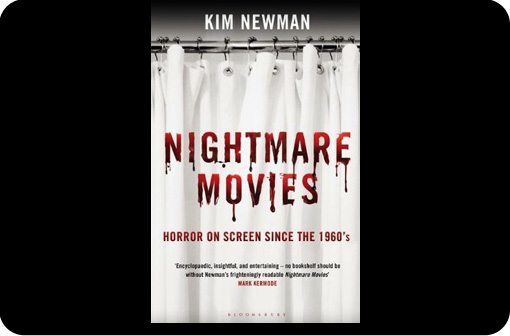

Author: Kim Newman
Publisher: Bloomsbury Publishing PLC
Out Now
Kim Newman is well-known to fans of horror and the cinema as a TV pundit, prolific reviewer and the author of the Anno Dracula novels. In its original form, Nightmare Movies was his take on film horror from the late 60s until the late 80s. In this expanded edition, the original book has become Part One, and a chunky second section has been added to cover all of the various trends since then. The result is an almighty tome that makes the Necronomicon look puny. When you consider the thousands of flicks namechecked and the hours perched on hard cinema seats they represent, it makes you marvel at Newman’s diligence and feel a sympathetic twinge for his long-suffering tush.
Along the way, Newman dusts off many a forgotten gem and writes thoughtful, balanced critiques of Argento, Cronenberg, DePalma and others, but that isn’t really the point of the book. Instead its purpose is to present an overview, identifying the dark currents that animate the murky waters of the genre.
Part One examines the rural carnage of The Texas Chainsaw Massacre and The Hills Have Eyes, revolt of nature films such as the John Sayles-penned Piranha and Alligator and the short-lived trend for devil movies (‘Rosemary’s Baby is a film; The Exorcist is a phenomenon; The Omen is a package.’) Part Two kicks off with The Silence of the Lambs (‘the only picture ever to score clean sweeps both on Oscar night and at Fangoria’s Chainsaw Awards’,) then moves on to encompass the 80s sequel mill, the 90s Gothic revival, the resurgence of the classic ghost story in the Far East, post-modern horror in the Scream franchise, torture porn, and even homegrown sub-genres such as hoodie horror.
As Newman anatomizes these permutations, Nightmare Movies sometimes feels less like film criticism than a work of natural history. A brilliant chapter on the Italian scene in the 60s and 70s, where directors were routinely raised high and cast low by rapidly changing cinematic fads, reads like a description of life in a tide pool. What might surprise some is the variety of specimens that find their way under Newman’s microscope. He doesn’t limit himself to films that are horror in a narrow, genre sense. As he explains in his postscript, ‘The story of horror in the cinema is larger than the story of the horror film … the genre seeps through unbidden into forms seemingly as alien as the war movie.’
A key example is Apocalypse Now, a ‘post-genre’ movie that draws from horror freely without being bound by its conventions. The potential of horror as a hybrid form is one of the key themes of Part Two. Like a character infected by a transformative parasite in a Cronenberg script, in the 90s the Hollywood mainstream (according to this thesis) absorbed hitherto near-underground strains of movie-making and spawned mega-budget, big screen mutations such as Interview with the Vampire and made unlikely heart-throbs of the serial killer and the un-dead. Trumping these in their turn, like a new breed of uber-monster, are recent blockbuster TV series such as Dexter and True Blood.
The heroes of Part One are George A. Romero and David Cronenberg, auteurs who used the horror genre to offer barbed commentaries on the zeitgeist and the individual psyche. The heroes of Part Two are David Fincher and David Lynch. In Fincher’s visceral style, Newman finds ‘a final evolutionary form of the horror movie,’ while Lynch evokes a mood of horror while discarding most of the genre’s obvious trappings (or so Newman argues in wonderfully persuasive passage that will send many viewers rushing back to Lost Highway and its successors.)
Not that genre horror is dead. In fact, the story ends on a note of termite-like hyperactivity, a flurry of franchises, remakes, spin-offs and straight to DVD sequels catalogued by Newman with unflagging energy.
Newman’s efforts to cram everything in mean that there are times when Nightmare Movies reads like an ultra-long version of his Video Dungeon column. (He even ropes in horror-related porn. Anyone for The Sexy Adventures of Van Helsing?) A particular problem with Part Two (although this is hardly Newman’s fault) is that some of its set piece films – well-hyped to begin with, then regularly repeated on TV – simply don’t feel all that fresh (whereas Romero and early Cronenberg remain exotic.) Across the whole book there is a tendency to give far more space to trend-significant films (Halloween, Hostel, Saw) than voices from the margins (Nicolaou’s Subspecies series doesn’t even merit a whole sentence.) As a consequence, this version of recent horror history might be a little middle of the road for some. Despite these quibbles, Nightmare Movies looks set to become a must for horror buffs, an invaluable tool for students and a sacred text for the next generation of Eli Roths and James Wans.