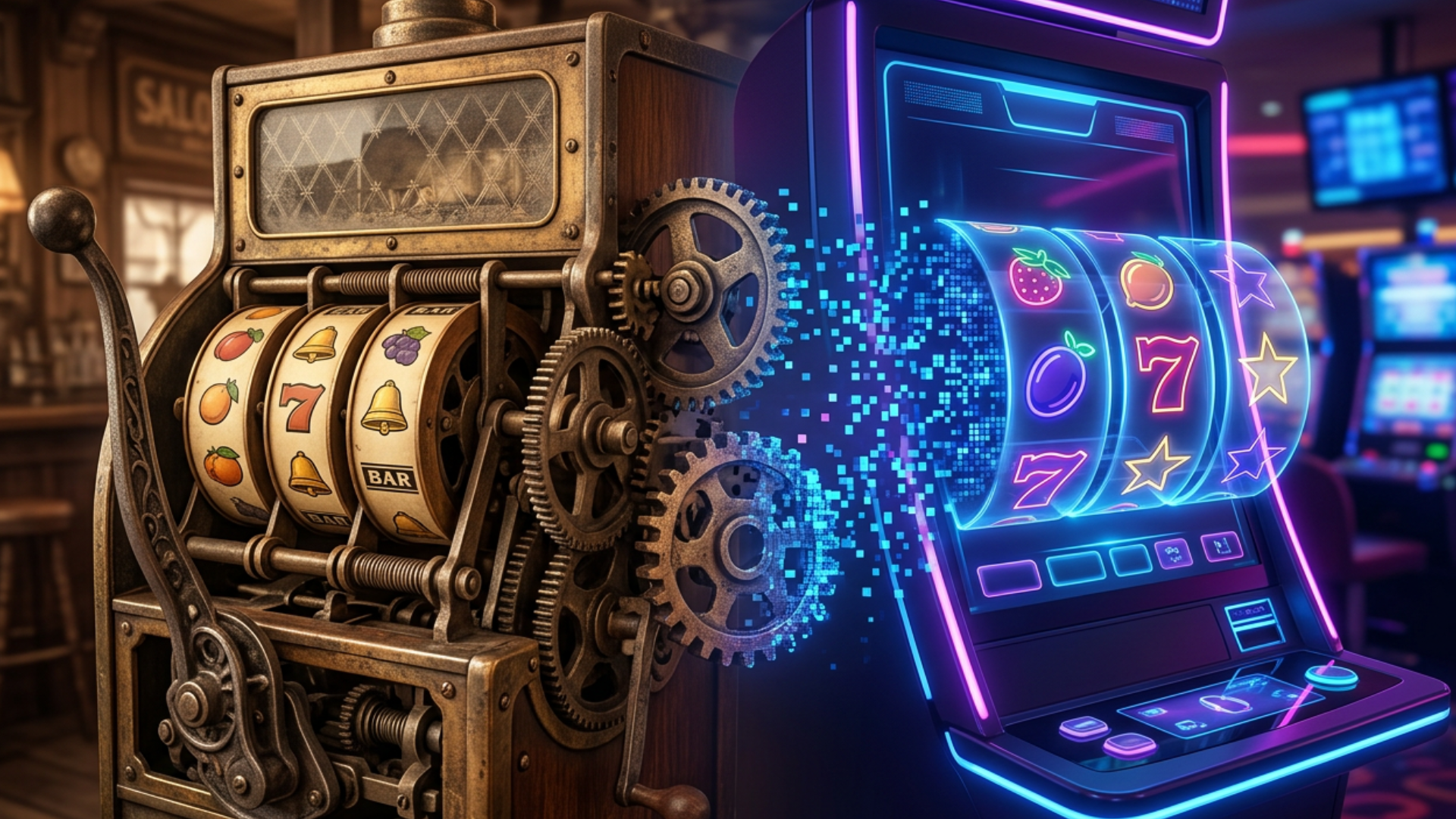
The modern slot machines found in land-based and online casinos of today understandably differ from the first mechanical devices created more than a century ago. While the objective of these machines has remained the same throughout, with each delivering random outcomes and rewards for specific symbol combinations, the technology behind them has evolved considerably.
Today’s slots are available in both physical form at land-based casinos and digital form at online casinos. Results are determined using complex mathematical systems and random number generators that are subject to testing and regulatory requirements in licensed markets.
However, the transition from mechanical reels to electrical and software-based systems and eventually online gaming has had a fundamental impact on how today’s games are designed and operated.
The Birth of Slot Machines
The origins of online slots and physical slot machines of today can be traced back to the late 1800s, when coin-operated devices first began appearing in bars and saloons across the United States.
- Sittman and Pitt Poker Machines: First developed in 1891, these machines would deliver random outcomes of playing cards. However, they were not automated, so winning hands were paid directly by the establishments they were in. In those days, it was not money, with prizes instead consisting of things like cigars and drinks.
- Charles Fey’s Automated Liberty Bell: A few years later, Charles Fey is widely credited with developing one of the first automated machines to dispense coins directly to players, the Liberty Bell, though some historians point to earlier automatic-payout designs it may have built upon. Symbols that could land on the three reels included many still seen on modern slots today, such as horseshoes and playing cards.
While they weren’t slot machines in the modern sense, Sittman and Pitt’s machines were the first to demonstrate the commercial appeal of coin-operated gambling devices and formed a big part of the early evolution of slot gaming machines.
As for the Liberty Bell, the machine is responsible for establishing many of the principles that define slots to this day. Players put their money in, the reels spin, and rewards are dispensed when certain symbol combinations land on the reels.
Fruit Machines and Early Commercial Growth
Charles Fey continued to develop slot machines well into the early twentieth century, but often had to adapt them to comply with changing gambling laws throughout the US. In some states where gambling was banned, his machines would no longer dispense cash, but other rewards like chewing gum, sweets or trading tokens instead.
The alternative prizes also began to influence the symbols on the machines. Fruit symbols that are still seen today were often used to represent the different flavours of the prizes being awarded.
Due to the growing popularity of slot machines, new manufacturers began entering the slot industry. Companies such as Mills Novelty started producing machines, helping expand their availability across the US and beyond.
Electromechanical Technology Changed Machine Design
One of the biggest technological jumps in slot machine history came in the 1960s with the introduction of electromechanical slot machines. There was no longer a complete reliance on mechanical components, with these machines combining traditional reels with electrically powered systems.
One notable example is Money Honey, a slot machine from Bally Manufacturing that is widely considered to be the first electromechanical slot to gain commercial success. Like others, it still had a traditional design and the iconic lever mechanism comparable with other machines at the time, but its electrical components allowed for the process of larger payouts and better reliability.
Video Slots Introduced Software-Based Gaming
The introduction of video slot technology during the 1970s marked the beginning of a shift towards software-driven gaming machines. Called video slots, these physical machines no longer used actual reels, but rather video screens to present virtual reels powered by computer systems.
Software now played the central role in the development of slot games. It would determine a game’s behaviour and also power the random number generators that were now responsible for producing random outcomes. Developers no longer had to deal with the limitations of physical reels or any other mechanical components.
Online Slots Shifted Development Towards Software
The widespread adoption of the internet in the 1990s was behind another major shift in slot machine development. While video slots brought software-powered gaming to life, online slots allowed people to play without the need for a physical machine. They could spin slots virtually at online casinos.
Going completely digital also opened the door for far more ambitious reel mechanics and bonus features. For example, rather than just paylines being used to determine results, innovations led to mechanics like ways to win, cluster pays and pay anywhere systems. Of course, as gambling regulation would also move to cover online slots, developers also had to adhere to various rules around RNG randomness and player safety.
Regulation Became Central to Modern Slot Development
Regulatory oversight began to get more technical for slot developers, who now had to create online slots that met a wide range of rules and regulations.
In Ireland, for example, the Gambling Regulatory Authority of Ireland (GRAI) is rolling out a licensing framework under the Gambling Regulation Act 2024 that will require online casino games to meet technical standards for fairness and game integrity, including the use of certified random number generators and independent, accredited testing laboratories before games can be offered to players.
The different technical standards required across regulated iGaming markets are one of the biggest challenges for modern slot developers. They have to balance game design, mathematical modelling, technical testing and regulatory compliance all throughout the development process of their games.
As a result, modern slots are no longer shaped purely by technological innovation, but also by the regulations that govern them. A fitting endpoint for a device that has gone from mechanical reels to fully digital, regulated software.