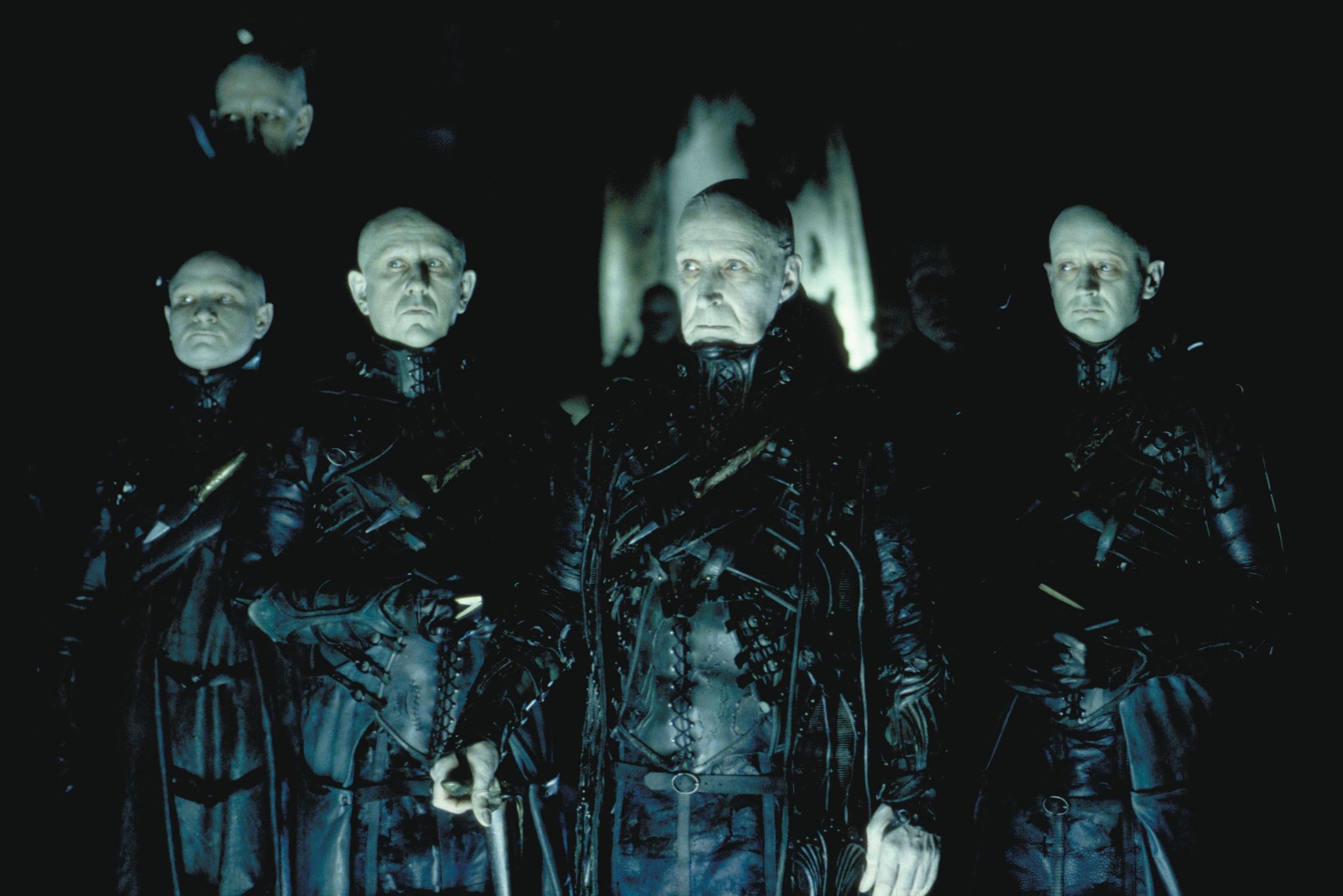
STARBURST spoke to Alex Proyas – director of The Crow, Dark City, I, Robot, Knowing and Gods of Egypt – about the special release of Dark City on 4K UHD from Arrow Video. We also spoke about his love of science fiction, existential dread, AI, remakes, Marvel, ‘the death of the big screen’, Stanley Kubrick, and his new film R.U.R.
STARBURST: It’s been 27 years since Dark City. What can we expect from the new release?
Alex Proyas: I’m thrilled to be seeing it myself for the first time when I present it at The Prince Charles Cinema [in London] in a few weeks’ time [14 July]. It’s my director’s cut, which I’ve never seen on the big screen before, so I’m excited about that. It’s great to present a properly restored 4K UHD version of the film. I’ve seen the transfer, but I’ve been watching on a computer screen. To see it on a big screen, I’m excited, the way it was intended. The theatrical cut was quite compromised. Arrow Video have done an amazing job. It’s extraordinary the amount of effort they’ve gone to, they’re a great mob.
Your films deal with big concepts. Dark City deals with Last Thursdayism, characters wanting to break free. A lot of people say it influenced The Matrix. In the 1990s, we had these sorts of films that resonate now. Why do you think they still resonate, and how did they influence today’s society?
More than ever, we feel the angst, the existential dread that I channelled in Dark City and some others did also. It’s more relevant today than ever before. When social media creates our little personal bubble, the algorithms give us a false reality that we can inhabit. From a consumerism perspective, they keep giving us more of the same stuff, as they know that’s what we want, that’s what we buy effectively.
I started writing Dark City in 1990. It was around for a long time before I made the movie. All of Hollywood read that script. No one wanted to make the film because it was ahead of the curve. It was only when I got to make The Crow that anyone seriously entertained giving me the money to make Dark City.
My influences – everyone says the shadows on the wall in the cave, the myth that inspired it [referencing Plato’s Allegory of the Cave]… it’s not actually that at all. I was aware of that myth, but I was more influenced by science fiction. I’ve been a huge fan of science fiction since I was a kid. I remember particularly reading a Brian Aldiss novel, Non-Stop, about history being falsified, and created, and the world was started around the year 1900. Everything before was a fabrication, I think by the state. It touched upon the idea that even humanity was fabricated and created in a test tube. That blew my mind. That’s really where the essence of the Dark City universe comes from, rather than other things that have been cited.
The thing about today, the world we live in right now, I think it’s all coming true. I keep saying we are living in an age of science fiction. When I was a kid, science fiction was off in the future somewhere. Even when I made I, Robot, it was science fiction. Now it’s kind of science fact. AI and social media and all these influences are driving progress so quickly, at a pace that I think many of us, as human beings, are having a hard time keeping up with.
Speaking of I, Robot, in this era of AI and drones and bots, where do you think this leaves us in terms of a society, and filmmaking in the next 20-30 years?
I think it’s all the same. The issue spans across every industry, every part of life. Every bit of commerce. We’re all suffering from that existential crisis where we don’t quite know whether we’ll have a job tomorrow. Not just in the film industry. It’s a fact of life. In the film industry right now, there’s a huge debate going on about the use of AI. One day I’m optimistic and hopeful, the next day I’m pessimistic, and I vacillate between these two extremes. I think the only real answer is, it’s going to happen whether we like it or not. It’s a fact of life that AI will take over. It already is. We just have to learn how we can retain our humanity and our sense of human identity through this construct, which will change everything. I think that’s the only hope. We have to learn to live with it.
It doesn’t help to negate it and stick your head in the sand. That’ll get you nowhere. Film is a technological medium; it always has been. Even in my relatively short career, we’ve gone from shooting on celluloid and editing bits of that and looking at the trims to non-linear editing, to digital cinematography. I’ve embraced every part of those things. For a human creator, it only makes our lives easier, and we can get to that fundamental emotion in our work that we’re trying to get to. It gets us there faster. Even writing has changed, from typing on a typewriter and using Tipp-Ex to make changes, to being able to work on any part of the script instantly, digitally. We have to learn to embrace this stuff. Much of it is very good. And retain our human identity and continue to collaborate with other humans as well as AI.
You touched on The Crow; the remake came out last year. You and others were against it, and it was critically and commercially panned. There seems to be a lot of remakes and reboots these days. Do you think some films should be left alone? Is it just a money grab, or are people out of ideas, or is something else at play?
I think it’s even worse than that. I think it’s the death of the big screen. The devaluation of original intellectual property has been off the charts for many years now. A shocking lack of imagination or acceptance of anything new from the powers that be, the financiers who run the industry, it’s been crazy.
I’ve been saying for years now, when Marvel dies, as it seems to be doing now, there’ll be nothing to replace it. All the studios have put all their eggs in one basket. People who have disputed that idea over the years say Hollywood has always been about franchises and particular genres. I say, yes, that’s true, but Hollywood has always had multiple genres running at the same time. When Westerns went out of fashion, the cop movie took over. There’s never been a time where it’s only been about people in spandex flying around. You put all your eggs in the one basket, and you’ll be dead. I fear that’s where we’re at now.
I see it when I pitch ideas of my own. Every time when science fiction with original intellectual property comes out and fails at the box office, I am distraught because I know that’s one more nail in the coffin. Some get through, but a decreasing number don’t. We’re not in a good place.
On the positive side – forget about plagiarism for a moment – it drives down the cost of producing film, a cinematic story. That’s a good thing for creative people. In terms of plagiarism, if you’re going to plagiarise something, you really don’t need AI to do that. That’s about the mindset of the people doing that. If you’re using AI, there’s ways of getting away from the potential of plagiarising other people’s work.
You’re working on a new film – your first since Gods of Egypt – R.U.R. It’s an adaptation of Karel Čapek’s Rossum’s Universal Robots. What attracted you to it?
It’s absurdist. It’s a satire. It’s where the word robot comes from, which I’m told in Czech means ‘worker’ or ‘exploited worker’. It’s about the capitalist system, how it’s fundamentally flawed, and it posits a Marxist view of the world. It was written in 1920, but it was a satire. I’ve reframed it in our AI age, as a kind of Kubrick-style Dr. Strangelove for the AI generation. I went back to Čapek’s original work because when I re-read it, I thought it was really cool. This is the origin of the robot story, the origin of any exploration of AI. And here we are in a world that is being overcome by AI.
The only way I can really comment as a filmmaker on our AI era is by going right back to the origin of it and making it a spoof as Kubrick did with Strangelove, where his only response to the imminent Armageddon of his era was to lampoon it and make it a complete farce. Once again, I’m inspired by Stanley Kubrick as I have been with pretty much everything I’ve ever made.
What attracts you to science fiction so much?
I read a lot of it as a kid at a formative age, and sat there imagining the movie as I read these wonderful books. It opened my imagination. This was in the 1970s when there wasn’t a lot of science fiction being made. I was inspired by movies like 2001: A Space Odyssey, which I saw as a kid, and my dad took me along. I saw it in 70mm, and it blew my mind. I had no idea what was going on, and neither did my dad, but I knew this was what I wanted to do. I was six or seven years old. When I discovered I couldn’t find more of the same in movies, I started reading these wonderful stories in literature. Then I was hooked on the genre combined with cinema. I wanted to grow up and make more movies like 2001. The arrogance of a young man! Not realising how hard it was to do that, let alone the market forces not wanting you to do that.
I’ve been offered a spin-off of 2001, which I find sacrilegious! Going back to your question about remaking stuff, I got offered a spin-off about HAL 9000! A modern spinoff of HAL. I was like, ‘are you fucking crazy?!’ You don’t touch that.
Going back to The Crow, yes, there are movies you should not remake. I don’t agree with any movies being remade. I’ve been offered many, and I go ‘why would I make this to be compared to a film that was brilliant in the first place?’ It’s diminishing returns.
The Crow is one man’s legacy, and it should remain that.
The 4K UHD version of DARK CITY from Arrow Video is out now.