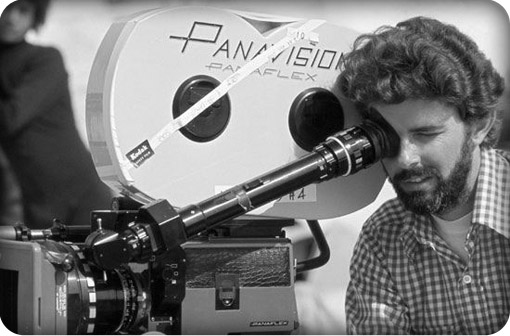

George Lucas’ retirement from blockbuster filmmaking recently will save us from more Jar-Jar Binkses, but it could also reveal a side of the director not seen since the 70s…
When George Lucas used a January New York Times interview to announce his retirement from blockbuster moviemaking, the internet celebrated. No, scratch that. It didn’t just celebrate. It partied like Rebel forces on the forest moon of Endor. No more prequels! No more Howard the Ducks! No more nuked fridges and Jar-Jar Binkses! Grab the nearest Ewok and boogie on down.

In fairness to the digital jury, Lucas’s retirement from blockbusters is indeed a good thing. But not for the reasons the message boards would have you believe. Lucas‘s new career path means he‘s now going to focus on smaller, less mainstream fare, and for anyone with an interest in his filmmaking beyond the galaxy far, far away, that is most definitely cause for good cheer.
Go all the way back to the start of Lucas’s career and you’ll find THX 1138. Lucas’s debut, this nightmarish sci-fi is light years away from Star Wars in terms of tone and theme, taking us into a world where the empire has won. It’s decidedly arthouse and one of the most intriguing and complex films of the ’70s. If Lucas is true to his word, this is the template for his filmmaking from now on.
THX 1138 takes place in an unspecified future and stars Robert Duvall as the eponymous hero who, like everyone in his society, is kept down by an oppressive regime that feeds its citizens emotion-quelling drugs. The film is an expansion of Lucas’s short Electronic Labyrinth: THX 1138 4EB, which was made during his time at the University of Southern California in the late ’60s. Fifteen minutes long, it features minimal dialogue, next to no character development and a wafer-thin story that is heavily indebted to 1984.

What makes it stand out though is its dazzling visual quality. Electronic Labyrinth was one of a number of abstract shorts Lucas made while at USC. In his younger years, the budding director fell under the spell of ‘pure cinema’, a filmmaking theory which argues that films should tell their story solely through sound and vision, rather than narrative and characters. Electronic Labyrinth was Lucas‘s most successful ‘pure cinema’ film, and after seeing it Francis Ford Coppola asked him to expand it into a feature and make it the first release from his newly-founded American Zoetrope studio.
The longer length, shorter titled, THX 1138 displays all the visual wizardry of its younger brother. Even the title sequence, which features swampy green text running down rather than up a jet black background, is a haunting experience. Set against Lalo Schifrin’s eerie synthesizer score, this functional filmmaking tool becomes a powerful mangle of sound and vision that’s perfectly used by Lucas to unsettle the audience and distort their perspective. Welcome to another world, it says with a glint in its eye.
Looking back on THX, Lucas said that he wanted that world to feel as grounded as possible and the film to seem like “a documentary from the future”. He achieved that goal by creating a smart juxtaposition between visuals and characters. Our heroes have jobs, they watch TV, they go about their everyday lives like there’s nothing wrong. Their existence is no different from our own and their reactions to the world around them are similarly normal. What they’re reacting to, however, is anything but.

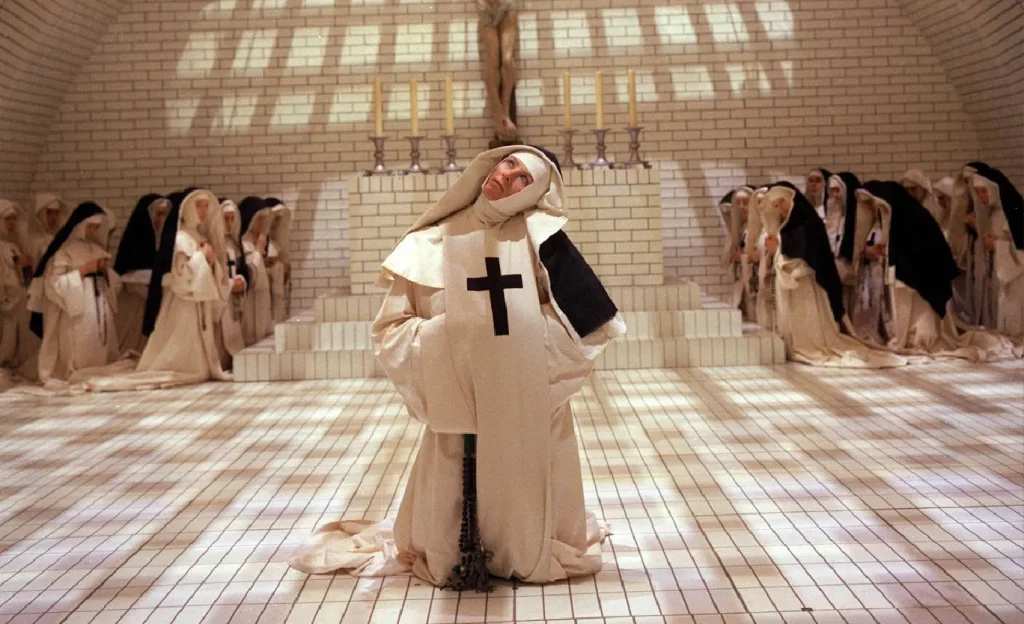
THX is a vision of a world created by the perfecting hand of technology. All pristine whites and immaculate structures, it brings to mind 2001: A Space Odyssey, which also made heavy use of whites. Kubrick used this clean aesthetic to ironically comment on man’s bid for perfection and his inability to attain it in an unknowable universe. Lucas’s intentions are less grand, though no less philosophical. His whites are more distancing than ironic. They are alien and alienating, stripping humans of their humanity.
Lucas enforces this isolation with his shooting style. His camera shifts uneasily from extreme wide shots to extreme close ups so the characters feel both trapped in and separate from their surroundings. His use of fades creates a similarly haunting effect. Scenes don’t cut neatly into each other, they lurch softly, suggesting a lethargy that reflects his characters’ disconnect. Faster, more intense would be the mantra on A New Hope; here it’s slower, more apathetic.
Lucas himself is anything but apathetic though. Pre-empting the rash of paranoid thrillers that would dominate post-Watergate America, THX is about surveillance, authority and mistrust. Lucas’ shooting style serves not only to show us the effects of these things, but also to envelop us in them. Through watching the film, we become as suffocated as the characters within it, and we are galvanized because of that involvement. At the end of A New Hope we feel like we can take on an empire; at the end of THX 1138, we feel like we must.

The film’s final shot features its sole natural element: a giant, raging sun. It’s a scene echoed in the famous dual suns sequence from A New Hope and the link serves as a potent reminder of Lucas’s approach to storytelling. We think of him now (for better or worse) as a writer, a creator of myths, but Lucas remains a student of ‘pure cinema’, a man obsessed with the storytelling capacity of the image. Perhaps that’s why his scripts often flounder: give him a pen and he’d probably prefer to draw with it.
By withdrawing from the narrative-driven world of mainstream cinema, Lucas is opening up a new chapter in his filmmaking that should excite all movie fans. It may not produce a film as good as THX 1138 and it’s unlikely to change the blockbuster scene he helped create or expand the tastes of those who devour its products. But with his money and power, the possibilities for interesting, unique films are endless. Slowly but surely, the man is re-emerging from the machine.
George Lucas has a new hope.